[Patreon-Nov16-Post-Bug][/Patreon-Nov16-Post-Bug]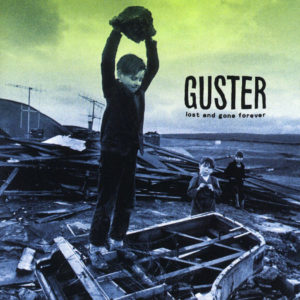 Lindsay, Erika, and I formed an only-child club together in 2001, but its origins were in 1999 and 2000.
That’s when five of the more senior members of The Drexel Players – Erika, Kate, Laurel, Megan, and Anthony – all shared the top two floors of an old row home at 3418 Race Street. For all of us Freshman, it’s where we decamped after every informational meeting, audition, and rehearsal. It’s where I met so many of the friends I still hold dear today, and where I met my entire wedding party (aside from Gina, who still factors into this tale).
There were certain records that never left the CD spinner in that house, such that their songs have become synonymous with one or more of those people for me. (Yes, CD spinner, though we were into into the heyday of Napster at this point.). Some of the records were the stereotypical white college kid things you’d expect – Dave Matthews was a frequent play, especially his Live at Luther College with Tim Reynolds.
Perhaps influenced by that choice, there was also Guster’s Lost and Gone Forever, produced by longtime DMB collaborator Steve Lillywhite.
Sometimes when I hear an album for the first time it seems so melodically obvious that I cannot believe I haven’t heard it before. Other times an album is so perfect that I consider every song a slice of 5-star perfection and can listen to it endlessly.
Lost and Gone Forever is both.
There aren’t a lot of catchy, pop-oriented bands that break through mostly on the power of acoustic guitars and harmony, which is the trick Guster somehow pulls on songs like “Center of Attention.” The amount and intricacy of Ryan Miller and Adam Gardner’s harmony is really quite incredible. It hardly ever sticks to the straight thirds most bands plaster their songs with. At points they’re what I’d call the nearest male analog to The Indigo Girls.
“Center of Attention” doesn’t really use any chords. Listen carefully in the first verse as it reaches the “walls inside my head” prechorus. It’s just a pair of riffs churning against each other to imply tonality. It’s also a perfect example of how Guster eschews the typical rhythm section of drums and bass, with most songs rooted by a baritone-range guitar figure and drummer Brian Rosenworcel pounding on all manner of congos, bongos, and even typewriters.

That doesn’t sound like it should make for great, catchy pop music and honestly it didn’t on Guster’s first two records. However, the combination of Steve Lillywhite as a producer and this remarkable set of songs created a whole that you could have never predicted by looking at the parts.
Lost and Gone Forever is an amazing record about the changing nature of friendship and platonic love, about selfishness and getting over yourself, and you can sing along to every song on it.
One of us won’t last the night
Between you and me it’s no surprise
There’s two of us, both can’t be right
Neither will move till it’s overI’m the center of attention
and the wall’s inside my head
And no one will ever know it
if I keep my mouth shut tight
The that motley crew of Drexel Players I met Freshman year shifted in 2000-2001 as I started this blog. Three members of the house moved away, which is how at one point Lindsay came to be renting Laurel’s back bedroom, and I came to be sitting around in the middle of the day with her and Erika watching game shows.
Just as there aren’t many memorable acoustic pop bands like Guster, there aren’t a lot of great, catchy songs about the mental defenses you construct as a clever only-child. “Center of Attention” is, without a doubt, the only-child’s anthem in that regard. I’d say, “maybe that’s just me,” but Lindsay and Erika have proven that it’s not. You’re not only your own protagonist, as every child is, but all of your adventures are entirely contained in the gossamer bubble of your brain.
Somehow (and I honestly still can’t quite explain it, even with copious posts from the time to aid my memory), the three of us wound up renting a house together in the fall of 2001. Three only children, each as selfish and stubborn as the other, all holed up in the top two floors of our own apartment on 44th street (where we’d later be joined by a fourth only-child (sort of), Gina)).
My own little world is what I deserve
Cause I am the only child there is
I’m king of it all, the belle of the ball
I promise I’ve always been like this
Forever the first, my bubble can’t burst
It’s almost like only I exist
Where everything’s fine
If I can keep my mouth shut tight, tight, tight
I think the reason we found each other and became (and remained) so close is because we’d each tried to outlast each other through the night and failed. Once that defense is finally knocked down, you’ve found someone with whom who you don’t always have to keep your mouth shut so tight.
 [Patreon-Nov16-Post-Bug][/Patreon-Nov16-Post-Bug]It’s the third installment of my “From The Beginning” read of

 – Must read!
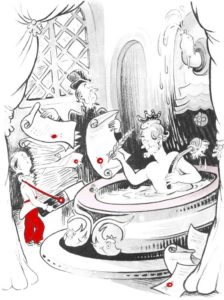 We also get the perfect antagonist to a cheerful and dutiful king in the shape of the officious Lord Droon. Droon is an early Grinch prototype, a nobleman with nothing noble about him who proclaims, “Laughing spoils the shape of the face.” Lest you think he’s championing an ahead-of-its-time anti-wrinkle platform, he continues, “The lines at the corners of the mouth should go down.”
 (Also, don’t lose sight of the fact that this is a king who sees his position as a duty rather than an excuse for laziness or petulance. Sure, his work is as whimsical as his play, but it’s refreshing to read a children’s book about a committed member of the royalty.)
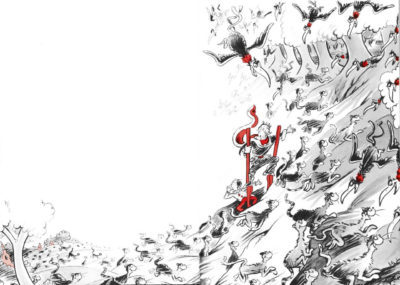 Despite nearly matching the length of 500 Hats, the prose in Stilts passes much more quickly while reading. Perhaps that’s down to the larger and more fanciful illustrations. Seuss repeats the spot-color red from 500 Hats, but here the color is used more liberally as a highlight. It’s the color of the stilts, but also of the Nizzards’ frilly necks and the Patrol Cats’ badges. Almost every major theme of the book gets a dash of red.
 She has now identified herself, the narrator, as an outsider to all of the beauty that she witnesses. Is that patronizing or is it acceptance and affection for the other?
 I saw so many friends who I hadn’t seen in a long time at the events held to remember Dante’s life. I gave all of those friends massive hugs, because that’s what Dante did every time he saw me. I spoke to them. We shared stories with one another.