Much to my amazement, our nearly 4-year-old seems to have quite suddenly gotten the hang of reading.
Actual reading. Not just spitting back memorized texted in a simulacrum of reading. I still remember the first time I witnessed that, because it was the day we told all our friends we were pregnant. It was our friend M’s daughter’s third birthday, and she “read” me an entire book from front to back. I was in total shock that she could read so many words and so quickly, until her father pointed out that she had simply memorized the entire thing.
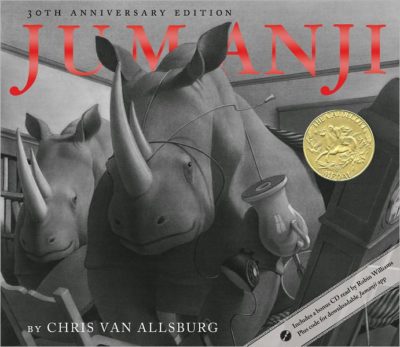
Our copy of Jumanji came with a CD of the audiobook narrated by Robin Williams. I put off playing it for EV6 as long as I could but finally the asking became more constant. I let her follow along with the book on the couch while I cried silently in the kitchen.
EV6 has always been good at memorization. It started one night when she was still impossibly small when she spat back the final page of Nightsong at me during her bedtime reading.
That was just the beginning. Since then I’ve heard this girl recite dozens of her books back at us – including a word-for-word rendition of Jumanji, and that is not a short children’s book.
Her current favorite thing to memorize is comic books, which I suppose must be slightly easier to do since you can focus on dialog balloons as if you are learning the script of a play. She has the entirety of the first 20 issues of Lumberjanes committed to memory. Sometimes she’s got it down after hearing it only two or three times, it’s amazing.
It’s amazing, and it keeps her nose buried in books all day every day, but it’s not reading.
I haven’t been too fussed with pushing reading skills on her while I’ve been staying at home. That’s in part because I learned to read so late, and partly because I feel like America’s school industrial process is overly quick to push advanced reading and math skills on kindergartners who aren’t always developmentally ready for them.
Despite that, I also haven’t ignored the skills. We’re always sounding out the words we encounter during the day and having little spelling bees on the refrigerator. I’s exclusively directed play and that’s fine. She’s three. I don’t expect her to read.
Or, didn’t expect her to read, because that’s what she’s been doing for the last week. [Read more…] about she can read (much to my amazement)

 – Buy it!
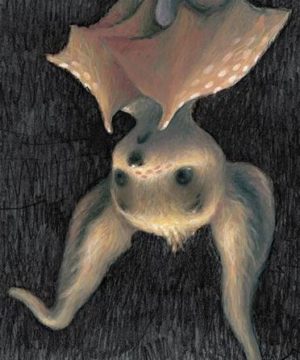 At first Chiro feels scared and disoriented, but when he begins to use his echolocation it lights up the details of the world for him as clear as day. After enjoying a breakfast of bugs, Chiro feels confident enough to keep flying. He explores as far as the ocean when he sees the glimmer of the rising sun and knows it’s time to return home to his mother’s warm embrace.
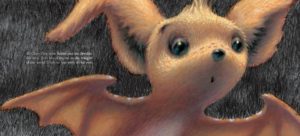 It begin with Chiro’s mother explaining exactly when he ought to push the boundaries she’s set for him – only when his song feels sure. We never get a moment of Chiro thinking to himself, “my song is sure,” but we do have the sureness threaded into the language throughout the book as Chiro’s self-confidence grows. As a result, his boundary-pushing is not only with permission, but it feels entirely organic for the character.
 [Patreon-Nov16-Post-Bug][/Patreon-Nov16-Post-Bug]Today is the fifth installment of my “From The Beginning” read of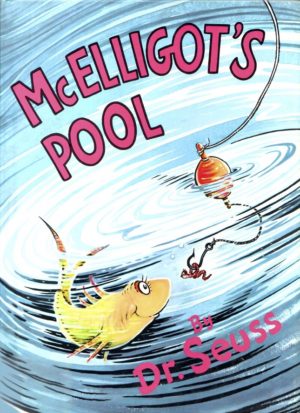
 – Consider it
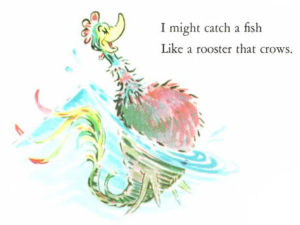 McElligot’s Pool is a really just an overgrown puddle, a hole-in-the-ground filled with water and people’s junk. A local farmer says Marco couldn’t possible catch a fish there even if he fished for fifty years! Even without the junk, I’m not sure that any fish would want to live there.
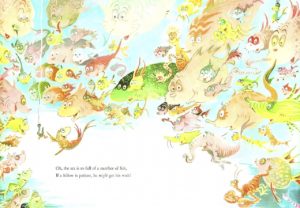 I found the book full of silly fish to be charming, but from the first read the toddler had found it to be boring. I wasn’t sure why at first. It has colorful illustrations and zippy, easy-to-read language. After negotiating with her to read it a few more times, I think her disinterest is the result of McElligot’s Pool lacking the progression of Mulberry Street. Though the fish do get slightly bigger and more unusual as the story continues, there isn’t a clear “this replaces that” theme nor a sense of reaching a destination. It’s just a list of silly fish.

 – Must read!
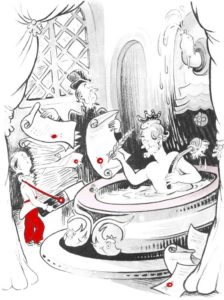 We also get the perfect antagonist to a cheerful and dutiful king in the shape of the officious Lord Droon. Droon is an early Grinch prototype, a nobleman with nothing noble about him who proclaims, “Laughing spoils the shape of the face.” Lest you think he’s championing an ahead-of-its-time anti-wrinkle platform, he continues, “The lines at the corners of the mouth should go down.”
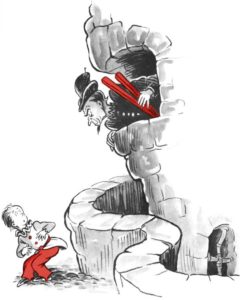 (Also, don’t lose sight of the fact that this is a king who sees his position as a duty rather than an excuse for laziness or petulance. Sure, his work is as whimsical as his play, but it’s refreshing to read a children’s book about a committed member of the royalty.)
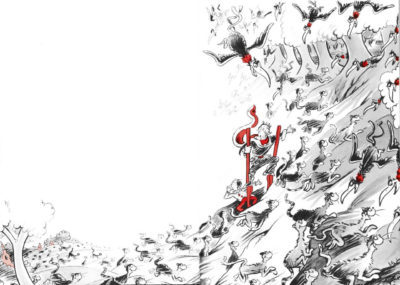 Despite nearly matching the length of 500 Hats, the prose in Stilts passes much more quickly while reading. Perhaps that’s down to the larger and more fanciful illustrations. Seuss repeats the spot-color red from 500 Hats, but here the color is used more liberally as a highlight. It’s the color of the stilts, but also of the Nizzards’ frilly necks and the Patrol Cats’ badges. Almost every major theme of the book gets a dash of red.